Institute
louis
Bachelor
louis
Bachelor








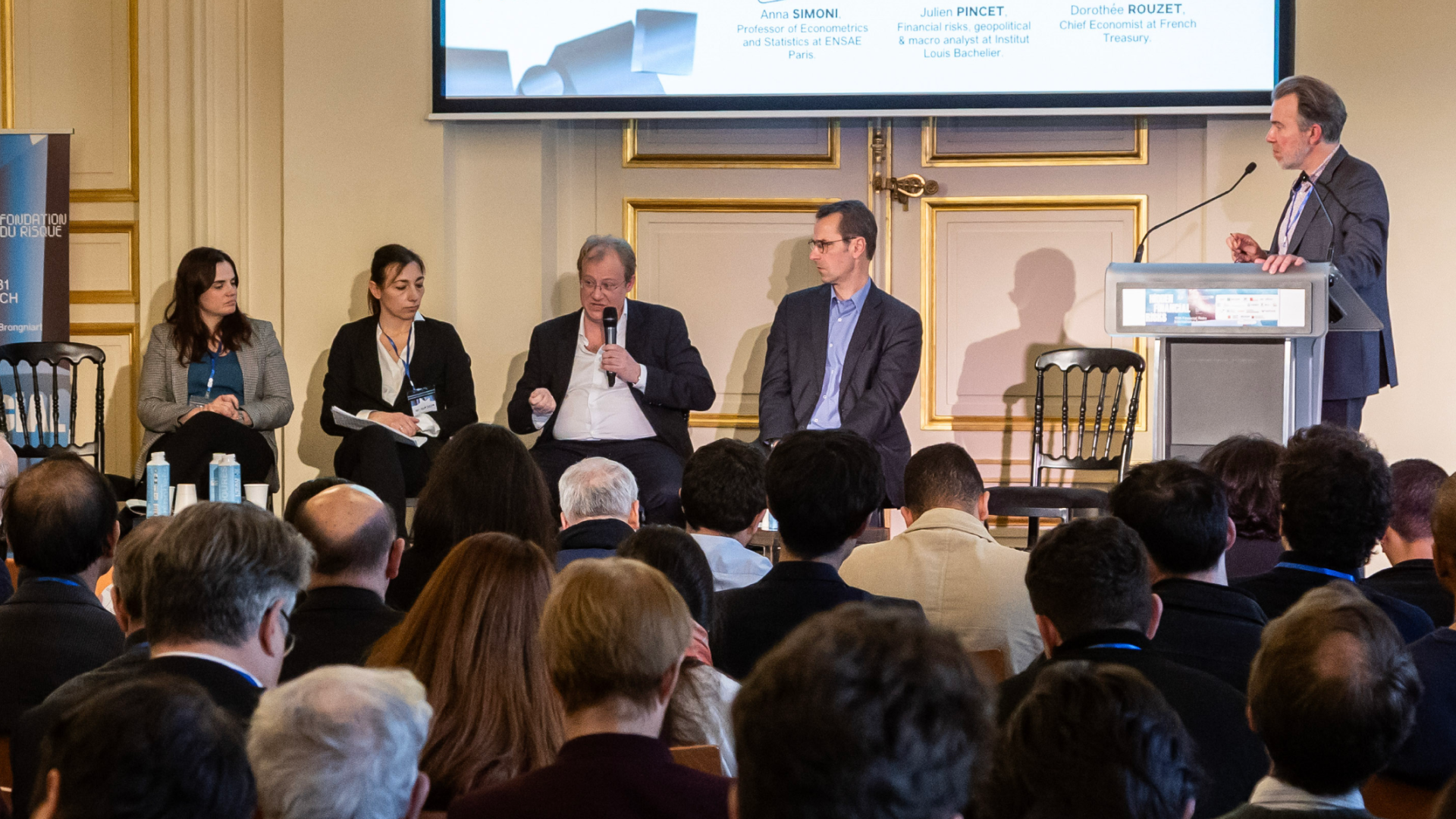
As part of the Institute Louis Bachelier's Risk Forum 2026, dedicated to "Hidden Financial Risks", a roundtable entitled "Measuring Geopolitical Risks and Their Impact on Investment and Financing Portfolios" brought together leading academics and finance professionals to explore the growing links between geopolitical tensions and financial stability.
Moderated by Charles-Albert Lehalle, Professor at the Center for Applied Mathematics (CMAP) at École Polytechnique – Institut Polytechnique de Paris, the discussion followed a presentation by Professor Matteo Iacoviello (Federal Reserve Board). The panel featured Dorothée Rouzet, Sébastien Jean, Anna Simoni, and Julien Pincet, who provided complementary perspectives on systemic vulnerabilities, the measurement of geopolitical risks, the use of data and artificial intelligence, and the practical implications for asset management.
Against a backdrop of trade tensions, strategic rivalries, cyber threats, and the increasing fragmentation of global value chains, the speakers highlighted the need for new analytical tools to better understand how geopolitical shocks propagate through the global economy and affect financial markets.
Dorothée Rouzet highlighted several areas of fragility that could amplify financial risks worldwide. These include elevated valuations and the concentration of investment in the U.S. technology and artificial intelligence sectors, historically high levels of public debt, the rapid growth of non-bank financial intermediaries (NBFIs), and the rising threat of cyber risk.
Sébastien Jean examined how geopolitical tensions spread through global value chains. He emphasized that geopolitical risk is driven by strategic decisions made by economic and political actors and is increasingly reflected in the fragmentation of international markets, particularly through export restrictions and new industrial policies.
Anna Simoni discussed the challenges involved in designing indicators capable of detecting weak signals of geopolitical risk. Market-based, text-based, and macroeconomic data now provide new sources of information, while machine learning and artificial intelligence techniques play a growing role in extracting meaningful signals from large and complex datasets.
Julien Pincet shared the perspective of institutional investors operating in an increasingly uncertain environment. He stressed the importance of rethinking diversification strategies by placing greater emphasis on supply chains, market infrastructures, and operational risks related to the custody and safeguarding of financial assets.
The discussion ultimately highlighted a profound shift in risk analysis practices. In a world characterized by growing uncertainty, institutions are moving beyond traditional forecasting toward forward-looking approaches based on multiple scenarios, enabling them to better anticipate potential disruptions and strengthen the resilience of the financial system.
The full transcript of this roundtable discussion is available for download below.