Institute
louis
Bachelor
louis
Bachelor




The Valencia floods, the California and French wildfires, and repeated flooding in Thailand have all left their mark on loan books, insurance claims and asset valuations.
The market of models and data providers that transform these hazards into financial impacts has grown exponentially in the last years.
How to help financial institutions understand these tools and find the one that suits best their needs?
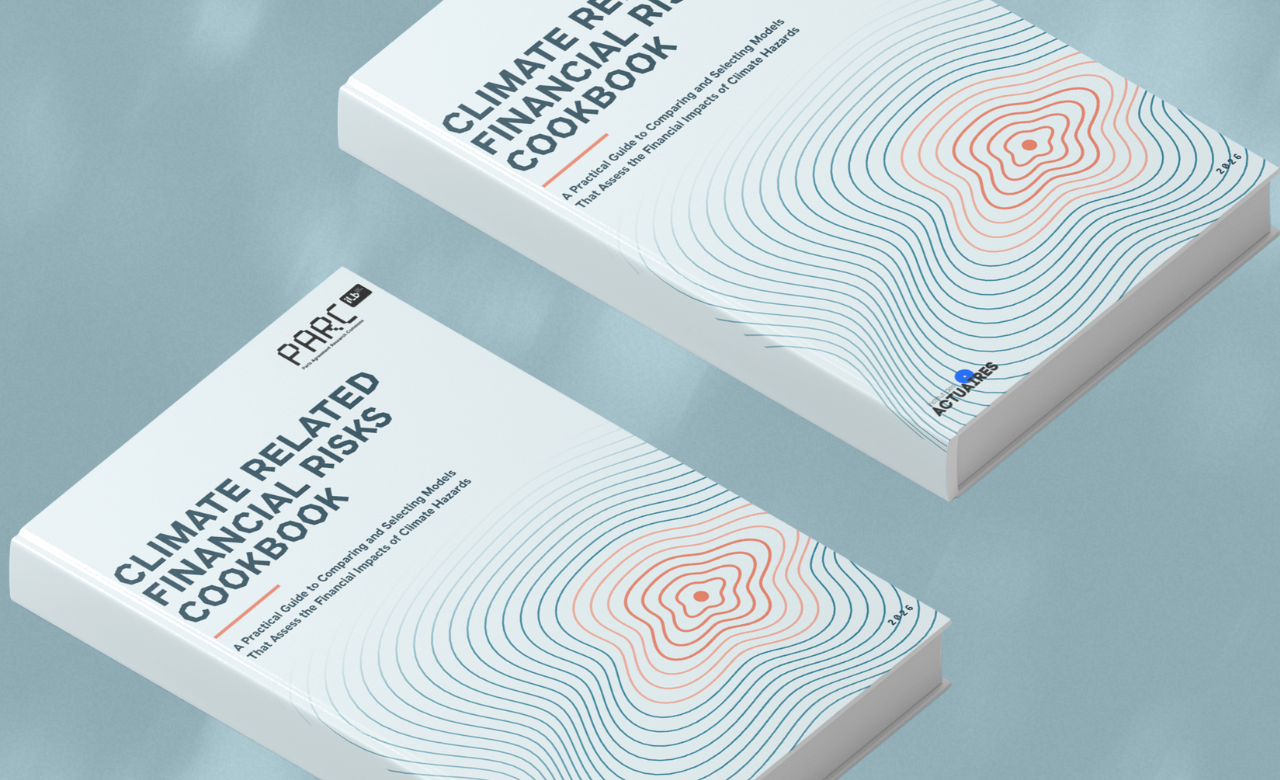
This is the question behind the Climate Related Financial Risks Cookbook, published by the PARC Foundation.
The cookbook does not try to name a single best model, because none exists. It gives practitioners a framework to understand how models work, the assumptions behind, and which one fits their own needs.
What you will find inside
The cookbook deep dives into approx. 40 models and builds on extensive interviews with data providers and financial institutions. It offers:
🔹 A clear reading of the transmission chain, from climate signal to physical hazard, damage, disruption and financial impact
🔹 A review of the main model families: damage functions and cat models, credit and default models, valuation models, network and systemic models, and scenario-based approaches
🔹 A practical toolbox for banks, insurers, asset owners and asset managers, organised around the financial object each one manages
🔹 Model cards, scale suitability statements and uncertainty disclosure cards, so that every result is read together with its limits and confidence
Coming soon: the Physical Risks Hub
The cookbook will soon be translated into an interactive platform, the Physical Risks Hub; a living catalogue of 250+ climate physical-risk models and providers, filterable by hazard, geography, and modeling-chain coverage. We will keep you updated.
Join our webinar on 24 November
Paul Vigneron, our post-doctoral researcher who wrote the cookbook, will present its main findings and share a using guide for financial institutions.
24 November, 4.30-5.30PM (UTC+01:00), ENG