Institute
louis
Bachelor
louis
Bachelor








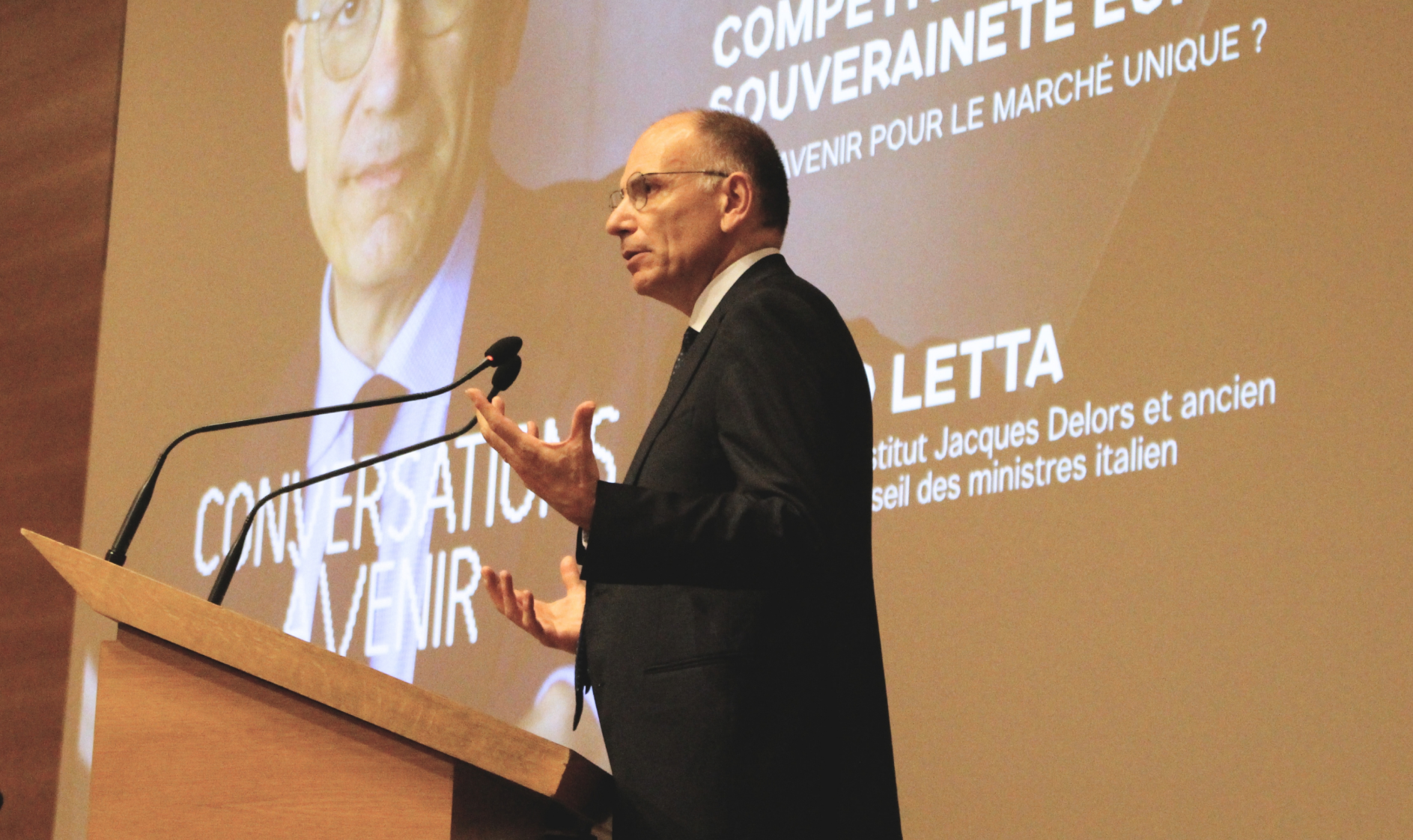
Competitiveness and sovereignty now go hand in hand with scale: this was the message delivered by Enrico Letta at the latest edition of the Conversations à venir at the Collège de France. A panel discussion then weighed his proposals against the realities on the ground.
Organized by the Institut Louis Bachelier alongside Isabelle Giordano, in partnership with the BNP Paribas Foundation, these Conversations à venir posed a central question: how can European companies be made more attractive and competitive?
Marie Brière, Director of the Institut Louis Bachelier, highlighted the scale of the challenges facing Europe: climate, demographic, and technological transitions, geopolitical tensions, and the need for a common defense. In this context, competitiveness depends on our ability to innovate, invest, train talent, and better mobilize household savings.
The evening also provided an opportunity to pay tribute to André Levy-Lang, founder of the Institut Louis Bachelier in 2008, who passed away this summer.
President of the Jacques Delors Institute and former Prime Minister of Italy, Enrico Letta presented a clear assessment: Europe can no longer be small, competitive, and sovereign all at once. To preserve its sovereignty and competitiveness, it must scale up through deeper integration.
Europe has already demonstrated its ability to succeed with the single market and the euro. However, its construction remains incomplete in strategic sectors such as energy, telecommunications, and, above all, finance.
The gap with the United States is particularly striking: Europe accounts for 17% of global GDP compared to 25% for the United States, but only 11% of global market capitalization, compared to 60% across the Atlantic. This financial weakness directly hinders its ability to fund innovation and technological breakthroughs like artificial intelligence.
Enrico Letta advocates for three priorities:
The stakes are high: Europeans are among the world's largest savers, yet a significant portion of these savings remains in bank accounts or is used to finance the American economy.
The roundtable, moderated by Guillaume Ledit, expanded on this observation: approximately 300 billion euros of European savings cross the Atlantic every year. Even European success stories like Spotify choose American markets for financing.
For Alain Papiasse, Chairman of BNP Paribas CIB, fragmentation is a major handicap: a European company must navigate 27 different markets and as many regulatory frameworks, whereas an American company benefits from a vast, unified market from the start. He advocates, in particular, for reviving securitization and further developing funded pension schemes.
Marie Brière, Head of Research at Amundi and Director of the Institut Louis Bachelier, highlighted another challenge: transforming investment into productivity gains. She identifies several levers: a management culture more conducive to innovation, more concentrated ecosystems, strengthened partnerships between startups and large corporations, and an increased focus on skills.
Fabrizio Pagani, a professor at Sciences Po, pointed to the considerable asset that is the European single market. To better direct savings toward the European economy, he advocates for concrete incentives: financial education, tax benefits, and better dialogue between companies and investors, all supported by credible public finances.
In conclusion, Enrico Letta called on Europe to seize the moment. Faced with geopolitical, technological, and demographic shifts, no single European country has the necessary scale on its own.
Deepening the single market is therefore not a purely technical matter: it directly impacts employment, innovation, wealth creation, and European sovereignty.
His final message summarizes the spirit of this edition: "We are stronger than our weaknesses."