Institute
louis
Bachelor
louis
Bachelor










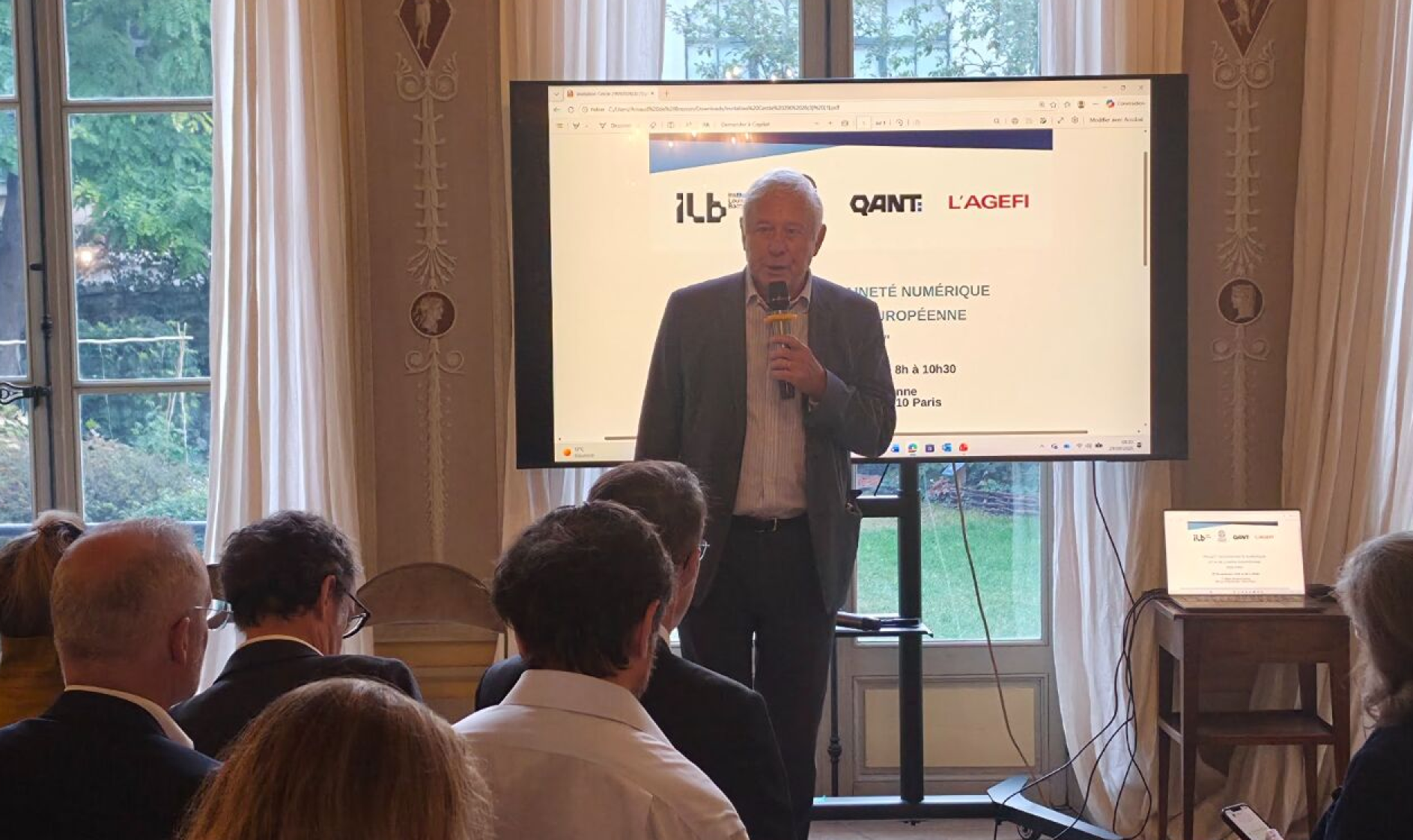
Having established its regulatory framework, Europe must now take on another challenge: financing, developing, and adopting its own artificial intelligence solutions. Experts, investors, and European representatives gathered at the Hôtel de Bourrienne to outline this new step toward greater digital sovereignty.
The Europe AI & Finance Circle, in partnership with the Institut Louis Bachelier, Qant, and L’AGEFI, organized a new working session following up on the meeting "How to build an autonomous European AI?"
On the agenda: the evolution of the legal framework, investment flows in artificial intelligence, and the European strategy to strengthen its technological capabilities.
Amélie Maindron and Gilles Rouvier opened the morning by presenting the new regulatory provisions that are reshaping the AI landscape in Europe. Olivier Martret then provided an overview of European investments in the sector: where is capital going today, and more importantly, where should it go tomorrow?
Thibaut Kleiner, Director of Policy Strategy and Outreach at DG CNECT of the European Commission, presented the guidelines for the "Digital Sovereignty and AI" package included in the next European budget, as well as the issues related to the Cloud & AI Development Act (CADA).
His assessment highlights three major obstacles.
The first is financing for scaling up. Europe is good at launching startups and funding their early stages, but faces more difficulty when they need to accelerate their growth. While the United States can rely on its pension funds, European savings are still not sufficiently directed toward financing these companies.
The second difficulty: demand. European companies are not yet adopting artificial intelligence on a sufficient scale to fully act as a driving force. Yet, building a European AI industry also requires having a market capable of purchasing and deploying its solutions.
Finally, the fragmentation of the European market continues to hinder scaling. Despite the existence of a common framework with the AI Act, differences between countries still complicate the development of companies capable of quickly expanding from a national market to the entire European market.
Faced with these challenges, the European strategy is built around three priorities.
The first is to better direct capital toward European AI companies. Deepening the Capital Markets Union should, in particular, make it possible to better mobilize European savings to support innovation and growth financing.
The second priority is to stimulate demand. The challenge is not just to foster the emergence of European technologies, but to accelerate their adoption by businesses, from SMEs to large corporations.
Finally, Europe intends to strengthen its technological supply across the entire value chain : data centers, cloud, AI models, and chips. The stated goal is, among other things, to triple European data center capacity.
This new phase marks an important evolution in the European debate on artificial intelligence. Digital sovereignty does not rely solely on the ability to set rules: it also depends on the ability to finance, produce, and use technologies.
Europe has talent, startups, and significant savings capacity. The challenge now is to transform these assets into companies capable of growing on the continent, as well as into technological infrastructure and large-scale applications.
After the time for regulation comes the time for investment. To build an autonomous and competitive European AI, the goal is now to foster a true ecosystem, from capital to infrastructure and users.