Institute
louis
Bachelor
louis
Bachelor








While defense, artificial intelligence, and competitiveness are taking up an increasing amount of space in economic debates, sustainable finance seems less prominent in the discourse. Is it actually in decline? A roundtable discussion held at the Cité de l’Économie provided a more nuanced perspective: far from disappearing, sustainable finance is entering a new phase, one more focused on measuring impact, the credibility of transition pathways, and the resilience of the financial system.
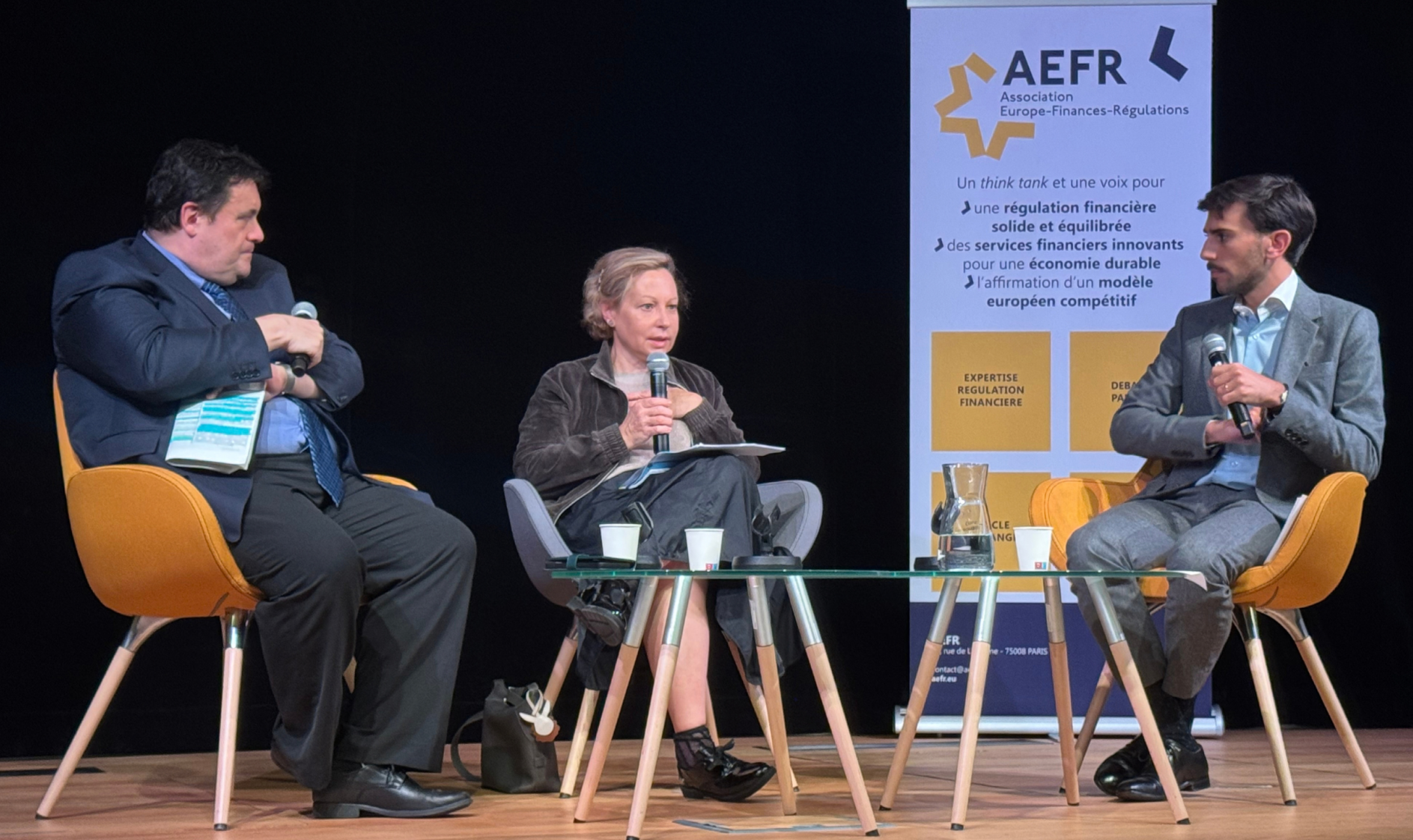
The Institut Louis Bachelier partnered with the AEFR (Europe-Finance-Regulation Association) and the Banque de France for this event, moderated by Cédric Fuentes, Director of Programs at the AEFR.
Joining the discussion were: Anna Creti, Professor at Université Paris Dauphine – PSL and Director of the Climate Economics Chair (Université Paris Dauphine – PSL / Institut Louis Bachelier), and Philippe Mongars, Deputy Director General for Financial Stability and Operations at the Banque de France and Deputy Secretary General of the Autorité de contrôle prudentiel et de résolution (ACPR).
In recent years, the economic and geopolitical landscape has shifted significantly. Issues of defense, sovereignty, competitiveness, and the rapid development of artificial intelligence have taken center stage in European priorities.
However, the needs related to the climate transition have not diminished. The question is no longer just how to mobilize more capital, but also how to ensure that the funding committed truly contributes to the transformation of the economy.
Sustainable finance is thus entering a phase of maturity: less focused on announcements and more on the measurement, robustness, and effectiveness of transition pathways.
A major shift: climate risks are now fully integrated into financial stability concerns.
Banks and supervisors must account for both the physical risks associated with climate change and the transition risks that may arise from shifts in public policy, technology, or business models.
Climate stress tests allow financial institutions to better assess their exposure to these risks, identify their vulnerabilities, and strengthen their resilience plans.
Climate is therefore no longer viewed solely as an environmental issue: it is becoming a component of financial risk management.
At the same time, sustainable finance continues to progress. Green bonds are growing, and the instruments designed to direct capital toward the transition are multiplying.
However, a gap remains between the funding mobilized and the scale of investment required. Transforming infrastructure, decarbonizing industry, supporting the energy transition, and adapting economies to the consequences of climate change involve significant needs.
The question then becomes whether the financial system has the capacity to support this transformation at a sufficient scale.
This is perhaps where the most significant shift lies: it is no longer enough to claim that an investment is "green" or that a portfolio is on a transition trajectory. You must be able to prove it.
The EU taxonomy, portfolio temperature alignment, and green CAPEX analysis are becoming essential tools for more accurately assessing the trajectories of companies and investors.
This evolution addresses a dual imperative: improving transparency and strengthening the credibility of the commitments made by financial actors.
Sustainable finance does not seem to be retreating so much as changing in nature. After a period marked by a proliferation of commitments and goals, it is entering a phase where the central question is now one of results.
Perhaps less visible, but more demanding: sustainable finance now hinges on the ability to measure the real impact of committed capital and to build a financial system capable of withstanding climate risks while supporting the transition.
Many thanks to Anna Creti, Philippe Mongars, and Cédric Fuentes for the richness of these discussions, as well as to the Cité de l’Économie and the AEFR – Association Europe-Finances-Régulations for their hospitality and collaboration.